4 Powerful Types of Brain Waves That Transform Your Mind
Have you ever wondered why you feel focused and completely zoned out? Or why some nights you wake up exhausted even after 8 hours of sleep? It’s because your brain is running on different frequencies. There are different types of brain waves. What I keep seeing is a pattern where people are struggling with sleep, focus, and anxiety, without realizing that their brain is the cause of all this.
There are technically 4 primary types of brain waves, but these four, delta, theta, alpha, and beta, are the ones shaping your mind every single day. By the end, you’ll know exactly what each one does and how to use that knowledge in real life.
What are the types of Brain Waves?
Brain waves are patterns of electrical activity produced by the brain. Our brain contains billions of neurons. These neurons communicate with each other via electrical impulses. When these neurons fire, they create synchronized patterns in our mind, and they form what scientists call brain waves.
These waves are measured by the [electroencephalogram (EEG)], and these brain wave frequencies are known as Hertz (Hz).
According to scientists, brain waves are slower when a person is in a relaxed, meditative, or sleepy state, and faster when a person is more alert, active, or in a stressed state.
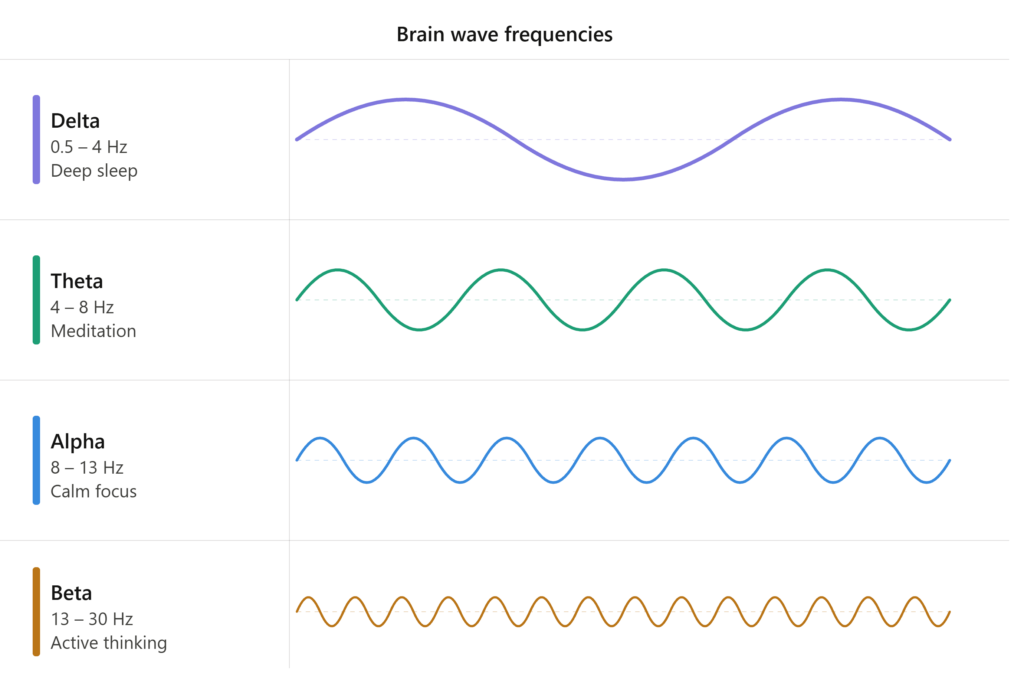
Brain waves are technically of 4 types (delta, alpha, beta, theta), each with a unique frequency: Delta (0.5 – 4 Hz), Theta (4 – 8 Hz), Alpha (8 – 13 Hz), and Beta (13 – 30 Hz). “As you can see in the image.“
The 4 Different Types of Brain Wave Frequencies
I’m going to tell you all four main frequencies your brain produces, what they do, and most importantly, how they affect your daily life.
Delta Brain Wave (0.5 — 4 Hz)

Delta waves are the slowest and deepest brain waves a human can produce. They are highest in amplitude and slowest in frequency range about (0.5-4 Hz), associated with the deepest stage of sleep and healing.
Delta waves are active during the deepest stage of sleep, also known as stage 3 of non-REM sleep. This stage occurs in the first half of the night for 1 to 3 hours after falling asleep. During this activity, our brain frequencies are very low in the range (0.5-4 Hz) and the awareness of the outer world completely disappears…
Most adults spend about 15 to 20% of total sleep in delta sleep, which is roughly 1.5 to 2 hours per night when sleeping for 7-9 hours. Delta sleep is important for recovery, mental health, and an immune system boost. Without enough delta sleep, you may wake up stressed, irritated, foggy…
Delta wave benefits
- Physical recovery: When under deep sleep this wave helps you recover by facilitating tissue and muscle regeneration, and overall rejuvenation.
- Immune booster: Delta waves enhance the body’s immune response by increasing the production of cytokines proteins to regulate our system and fight infection.
- Brain detox: Delta waves are the only ones that seem to be involved in clearing unhealthy proteins out of our brain during sleep. This involves large waves of cerebrospinal fluid (CSF) that couple to delta waves.
- Hormone release: During delta sleep, the body releases melatonin and DHEA (dehydroepiandrosterone), the “youth hormone.” Delta wave activity supports the release of growth hormones, critical for cell repair, muscle growth, and vitality.
Theta Brain Wave frequencies

Theta waves operate between (4-8 Hz). They occur when your mind is relaxed but not fully asleep. You naturally enter the theta state during day-dreaming, light sleep, meditation, and moments just before falling asleep and waking up.
When we are in the theta state, our brain slows down, entering a relaxed stage to achieve mental clarity and emotional well-being.
I tried a 12-minute theta audio for a week straight. The difference in how fast my brain settled into that creative, relaxed state was something I wasn’t expecting. If you want to feel what real theta actually feels like. This is what I used →
Theta Brain Wave Benefits
Enhance creativity and intuition: when the theta wave is active, our brain stops analyzing and allows ideas to flow. Many people experience sudden imagination, an ‘aha’ moment in this state. When you’re in a relaxed, dreaming state this helps you to become more creative.
Reduces stress and anxiety: when you’re in a theta wave state by creating deep relaxation. You get that deep because of activities like meditation that allow you to lower stress and calm the nervous system.
Enhances emotional healing: Theta waves help process emotions and traumas stored deep in your subconscious mind. Therapists use theta states through “hypnosis” or guided meditation to help people work through issues.
Theta waves are the frequency of healing, high creative states, and improved memory. Doing meditation or listening to brainwave audio (using brainwave audio helps you to achieve it faster), which leads to improved sleep, stress relief, etc.
Alpha Wave Frequencies

Alpha waves are the type of electrical activity (range between 8 to 12Hz) that appears when you feel relaxed and alert at the same time. It usually occurs when you’re engaged in activities like meditation or daydreaming.
Researchers suggest that these waves may play a role in reducing depression symptoms and improving creativity.
When Alpha Waves Are Active:
The wave is active when you’re relaxed without falling asleep, and your brain is not overloaded with tons of information. It’s that “Zen” state where everything just flows.
Alpha waves show up when you close your eyes, take a deep breath, or listen to calming music. That’s the moment before you drift to fall asleep, and that’s alpha transitioning you from active thinking to rest.
Alpha Waves Benefits
Reduces stress and anxiety: Well, alpha waves have their own way to solve the problem, like stress, and it increases the wave frequencies when you meditate just like theta waves. It literally shifts your brain to reduce the stress hormone and sets you in alpha mode.
Improves focus and concentration: Alpha helps you stay focused. You’re alert but not stressed. Students in alpha state absorb more information, and workers in alpha mode get more done with less mental fatigue.
Promotes better sleep: Unlike beta waves, alpha waves make sure you go from awake to asleep smoothly. If you struggle to “turn off” your racing thoughts at night, it’s because you can’t shift from beta to alpha. Whereas alpha waves make sure to enhance your sleep quality.
With alpha wave, you can have better sleep quality, immersive focus and concentration, and reduce stress. If you want to learn it fast, the best way is to do meditation in the morning to be more productive throughout your day.
Read my (How To Manifest Wealth) article, where brainwave influences most of it.
Beta Wave Frequencies

Beta waves range between 13 and 30 Hz. These are your “get things done” brain waves. The ones that dominate when you’re awake, alert, and actively engaged with something.
Beta waves are active when you’re awake and thinking. Working in your office, having a conversation with your colleague, reading an article, or anything productive for you. In simple words, beta waves power your thinking and action.
Conversely, suppression of beta waves can lead to ADHD, daydreaming, depression, and poor cognition. Research shows that people diagnosed with Attention Deficit Hyperactivity Disorder (ADHD) have decreased beta brain wave activity.
Beta can be broken down into three ranges:
- Low beta (12-15 Hz): Relaxed focus, like when you’re concentrating but not stressed
- Mid beta (15-20 Hz): Active thinking, problem-solving, getting work done
- High beta (20-30 Hz): Intense focus or… stress, anxiety, and racing thoughts
The fastest way to pull your brain out of high beta isn’t a break or deep breathing. It’s intentionally dropping into theta. I found a 7-minute audio that does exactly that. Check it out →
Beta Wave Benefits
Improve focus and concentration: Beta waves keep you mentally sharp and help you concentrate on tasks that you are currently doing. Because beta waves are already active in your brain most of the time. Beta waves do the lifting for you when you need to analyze information or stay alert while driving.
Supports multitasking: Beta allows you to juggle multiple tasks, switch between activities, and maintain focus under pressure.
Keeps you alert and engaged: Beta waves prevent your mind from wandering off into daydreams. They keep you present and connected to your surroundings.
Here is the catch. Beta wave helps you to stay active and alert, but when you’re heavily stressed, your whole brain system jumps into multitasking because of the workload you have. It led to mental exhaustion and anxiety. Keep a balance in your life, approach the wave activity for focus when necessary to complete tasks while preventing mental exhaustion.
The conclusion
There you have it. The 4 Types of brain waves frequency to shape how you think, feel, and perform every single day.
Delta gets you deep, quality sleep. Theta gives creativity and intuition. Alpha brings calm focus. And Beta keeps you sharp and productive (when you’re not overdoing it).
Understanding these brain wave frequencies is just the first step. The real power comes when you learn to shift between them on purpose. (Theta for breakthroughs, alpha for clarity, and delta for recovery, and beta for productivity.)
Your brain is powerful. Now you know how it works.